Reading Time: 2 minutes

To non-surfers, the Northeast seems an unlikely place to find good waves. It’s not California, not Hawaii and too cold most of year to get in the water… right? It seems a well kept secret that waves here in the Northeast are sometimes great and with the right gear it’s never too cold!

The only time cold-water surfing hurts is when it comes time to get out of the water and strap the boards on the roof. I’ve dropped my fair share of F-bombs when my fingers and face froze while fumbling to get my fish fastened (fins forward friends).
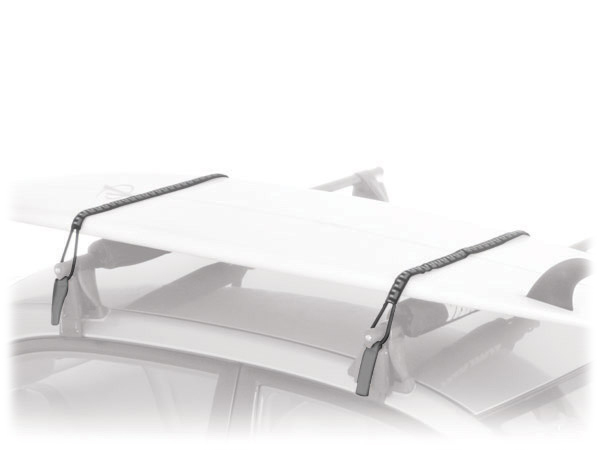
This year a revelation – the Yakima StrapThang which retails for about $70. Now cold-weather surfers everywhere can quickly and securely fasten up to 2 boards (or a board bag) with two quick pulls on bungee cords that hook over special bar-ends (part of the StrapThang package). The time from ocean, to car, to shower (still in your suit mind you) has never been quicker or easier.

I use the Yakima StrapThang in the warmer months too. While my friends are busy weaving straps and fastening buckles, I’m out of my suit and hitting Joyce’s for an early pint, or grabbing some breakfast at the Ocean Mist after dawn patrol. It’s also the quickest way to get in the water too, with no knots or buckles to undo you can simply release the cords, grab the board and go.

The StrapThang probably works with other rack systems, but you need the included hooked bar-ends which are made for the Yakima system. These ensure that the bungees don’t release unexpectedly and your board goes sailing. The StrapThang should also be used with crossbar pads, Yakima sells theirs for about $30.

The loops on the StrapThang are the right size for bare fingers, but not quite big enough for gloves (at least not over 5mm), so you may want to add some cordage as I did to make a larger loop that’s easier to grab.

If you are looking for a reliable rack system for surfing you need to check out the Yakima StrapThang. Surf more, freeze less.

Posted by: Lawrence
Reading Time: < 1 minute

Here in the Northeast we were just blessed with great surf for the past 4-5 days. I was fortunate enough to make it out for 3 of these days and loved every minute of it… almost.

One of the most frustrating parts of surfing is after earning your wave in a lineup, dropping in and realizing when you pop-up to stand, your feet are tangled in the leash. Called ‘hog-tying,’ this is not only frustrating, it can also be dangerous since your realization often begins when you are coming down the face of the wave.

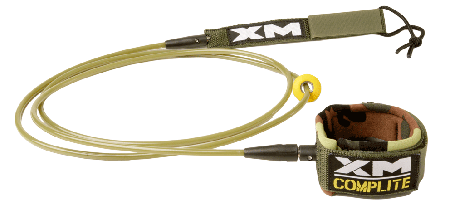
A few weeks ago I talked with local surf legend Peter Pan who swears by a leash called the XM Tangle Free leash. The concept for this leash is so simple, a small sliding weight on the cord creates just enough drag to keep it shaped and behind the rider, thus preventing it from sneaking up and hog-tying your feet.

Recalling my conversation with Pan I headed to his surf shop Gansett Juice and picked up the 9′ XM Comp leash. This leash has a .220 diameter cord Double Swivel Comp with Slider (the regular XM Tangle Free has a .270 cord). Now I don’t get tangled every session, but I do feel the leash around both feet every session and I have to say with the XM Tangle Free leash I never felt the leash around both feet. Not even once.

Check out the video below to see the leash in action and if you surf and have ever been hog-tied, think about buying the XM Tangle Free leash. Even if you already own a leash, it’s always best to have one on stand-by in the event yours breaks mid-session in epic conditions!

Posted by: Lawrence

Reading Time: 2 minutes

Over my lifetime I’ve done perhaps hundreds-of-thousands of pushups, usually as a form of punishment for poor performance in karate and sports. I still hear my coaches screaming ‘drop and give me 30!‘ and it always puts me in a cold sweat. In the military if you screw-up you have to do pushups in a muddy puddle during a rain storm (it’s true, I saw it in a movie).

Considering that pushups are commonly used as a form of punishment, why would someone want to do pushups? Done properly they’re in an excellent form of exercise. Pushups work a variety of muscle groups (pectorals, triceps, deltoids and the midsection in general), build strength as well as stamina. Pushups also require little space, cost nothing and generally take little time to perform for maximum benefit.

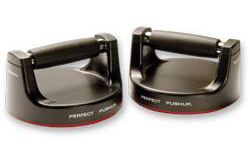
The Perfect Pushup improves the effectiveness of traditional pushups while at the same time reduces strain on your wrists. With the Perfect Pushup, your arms naturally rotate 90° through the pushup, simultaneously engaging more muscles from your shoulders to your abs. This motion is far more comfortable than traditional pushups and more efficient. By changing positions (knees, traditional and feet on a chair), changing the width (distance between the perfect pushups from close to wide) and changing starting grip positions (thus changing rotation through the pushup) you can add variety to your workout.

When I tested the Perfect Pushup my max dropped in half compared to traditional pushups, but the workout itself felt more beneficial. I felt other muscles working that I don’t normally feel with traditional pushups. I also liked being slightly elevated in the front as it allowed me to bring my face closer to parallel with my face without kissing the ground.

For it’s small size, durable construction and low price, the Perfect Pushup is a must have for home gym owners. Also check out the portable version which is handy for travel. Now drop and give me 30 15!

Posted by: Lawrence

Reading Time: 3 minutes

Last weekend I participated in the inaugural “Druid Challenge” ultramarathon, along the Ridgeway, a beautiful, tough trail, just to the northwest of London.  I did it because:

(a) I wanted to get motivated to do some long-distance running as I train to tackle my first Ironman this year

(b) I wanted do a small event that was likely to be filled with camaraderie and collegiality more than competitiveness and PBs

(c) It seemed like a really interesting, well organised event that was amazing value for money – £90 (around $150) for 3 days of running, transportation, food,  accommodation and support.

It satisfied on all 3 points. I learned a lot about long-distance running, my strengths, my weaknesses and how to be better prepare for similar challenges in the future.  I also learned some valuable lessons about running kit, such as:

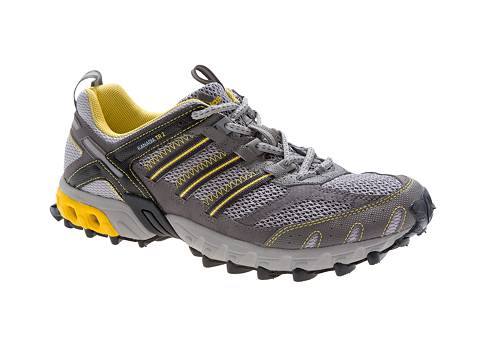
– Get the right shoes for the right conditions. I ran with Adidas Kanadia TR2 trail-running shoes and they were the right combination of lightweight shoes with some grip for the slippery trails.  And then wear them, train in them and get used to them. I probably should have gone more out of my way to run through puddles and clomp around the mud, running up and down hills than I did before the race.

– Get a good bag that fits you well and holds what you need. I ran with the Inov-8 Race Elite 15, which turned out to be just right for this event. I was tempted to go for a larger pack that could hold more, but it would have been too much for this race, which was well-supported with aid stations on average once every 8 miles. As it was, I probably carried way too much, but was also quite glad to have those extra Clif Shot Bloks and Torq gels to keep me going throughout the race.

Compeed blister patches are life-saving little packets of miraculous wonder. I couldn’t have finished the race without them, and without the generosity of Cyril, my motivator on Day 2 who gave me his large-sized ones when he saw the size of my blisters.

The camaraderie, the mutual support, the friendliness and general lack of ego of everyone I met was overwhelming. I mean, literally, overwhelming. I am still reeling from the kindness and inspiration of everyone I met. Examples:

– I had dinner on the second night with a guy in his late 50’s who has done over 200 marathons, more than half of which he does in around 3.5 hours. He’s at the point where he’s been doing an average of one marathon a week for the past 2 years (it took him about 15 years to reach his first 100, and then he just sort of decided to turn it up a notch).  He wasn’t bragging or boasting or saying any of this to impress me, but just because it came up in the conversation at dinner.

– Everyone, no matter how slow or fast, was totally ‘kin’ awesome. If faster people ran past you, they cheered you on for your efforts and got cheers from all of us slower folks. If you ran past slower people, then you did the same for them, cheering them on, joking about the weather or the mud or the hills or the rain or anything else you could think of.

– On the morning of the last day, a guy was hanging out in the breakfast area, asking a couple of us how we were doing and were we ready for the last big push today. He lamented that he wasn’t out there with us today as he had signed up to do this race, but he still wasn’t fully recovered from this year’s Marathon des Sables after he lost all the skin on his feet, but he wanted to be on support crew and cheer us on at the finish line. ‘Kin’ Awesome!

Indeed, it seemed like every other person at this event was either training for the next Marathon des Sables (or MDS as everyone shortened it to), had done one at some point, or was on the waiting list to do one.

It made me feel positively sloth-like. Training for an Ironman just doesn’t seem like such a big deal after this weekend.

Posted by: Robert